Frequently Asked Questions
Wire Transfer & Stock Gift Instructions
Please find our instructions for Wire Transfers and Stock Gifts here
How Endowment Works
Establishing New Funds
Should a new fund be set up this fund with the Foundation or with The Regents?
The general guidelines are:
Recommend set up as a Regents gift fund:
If the donation is (1) a one time gift and the department expects to spend the entire amount within the current fiscal year, (2) a fellowship with a named Fellow, (3) a gift for a Pooled Income Fund, (4) Real Estate NOT TO BE SOLD, (5) gift-in-kind to be added to departmental inventory and not sold, (6) small memorial/honorarium gifts, we recommend you set the fund up with The Regents directly. A new Regents' gift fund number will be assigned and the funds can be expended for the purpose designated by the donor. All gifts require a gift letter, solicitation, proposal, and any other related correspondence that document a donor's intent be provided to Gift Services.
Recommend set up as a Foundation gift fund:
If a department has (1) one-time, multiple or regularly recurring gifts (pledges) for the same purpose, (2) gifts of real estate for immediate sale and highly marketable or with special circumstances, (3) art gifts, (4) gifts of stock, (5) Endowed gifts, (6) most gifts for capital projects, (7) annual benefits/solicitations/fundraiser events (gifts with quid pro quo), (8) Planned/Deferred Gifts (Lead Trusts, Life Estates, Gift Annuities & Charitable Remainder Trusts), the fund should be established with the Foundation. All gifts require a gift letter, solicitation, proposal, and any other related correspondence that document a donor's intent be provided to Gift Services.
Gifts of real estate, art or stock:
When gifts of this nature are given, there are various appraisals, valuations and other items involved prior to gift acceptance. The Foundation office is local and has expertise in processing gifts of this nature, thereby ensuring that the monies are made available to the department as quickly and efficiently as possible.
Regardless if the gift is to the Foundation or to The Regents, each gift is key entered by the gift services staff and a gift receipt and a thank you note is generated for each gift.
What do the letters mean in the fund number?
Gift funds are alphanumeric. If the fund starts with A through L, it is a UC San Diego Foundation fund. If the fund starts with M through X it is a UC Regents fund. Each letter represents the restriction level of the fund.
A current fund is a fund in which all gifts to the fund can be spent for the purpose designated by the donor.
An endowment fund is a fund in which the original amount of the gift (endowment principal) is invested in perpetuity for appreciation. Only the expendable income (payout) allocated to the endowment expendable fund may be spent on the purpose designated by the donor.
Foundation |
Regents |
Description |
| Current-Use Funds | ||
| A | M | Unrestricted |
| E | R | Restricted |
| Endowments | ||
| K | W | Endowment Principal |
| F | T | Restricted Endowment Expendable |
| B | N | Unrestricted Endowment Expendable |
| Unrestricted FFEs | ||
| C | Unrestricted FFE Principal | |
| D | P | Unrestricted FFE Expendable |
| Restricted FFEs | ||
| G | Restricted FFE Principal | |
| H | U | Restricted FFE Expendable |
| Trusts/CGAs | ||
| J | V | Trusts/CGAs for Restricted Expendable |
| L | X | Trusts/CGAs for Endowment Principal |
Use of Gift Funds
How does my gift get to the department that will spend the funds?
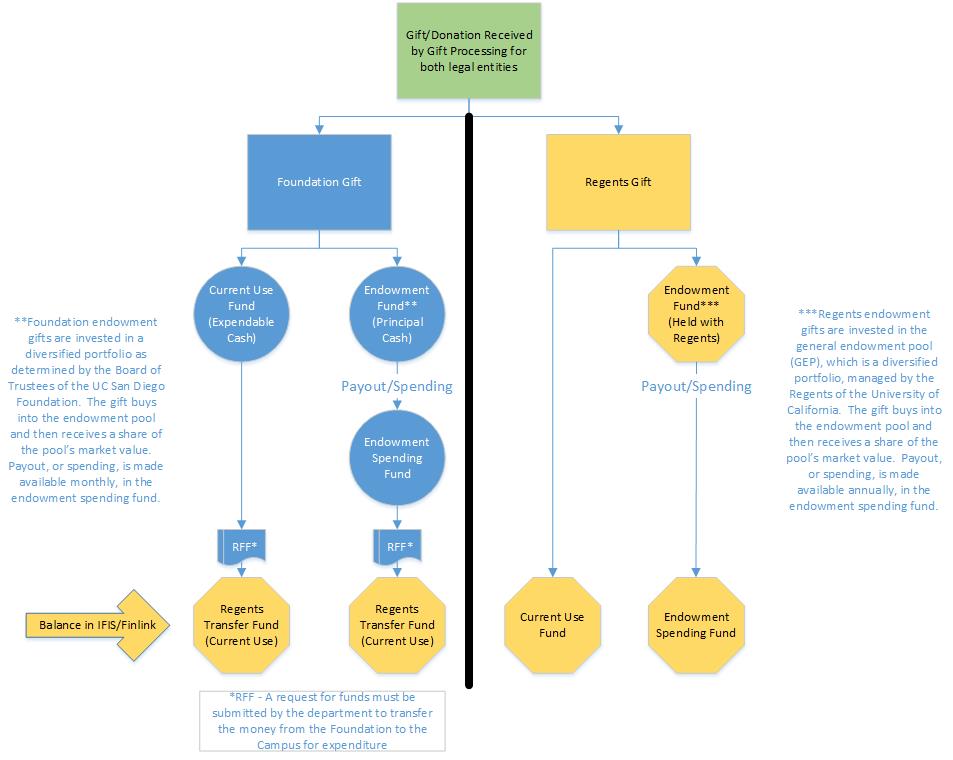
Foundation expendable gift and endowment payout balances are transferred to the Campus ledger monthly, one month in arrears. For example, a gift or payout received in March will be reflected on the Campus ledger in April.- Delays in the transfer of endowment payout will occur during the first quarter of the fiscal year due to fiscal year-end dependencies.
Regents' expendable gifts will be recorded during the month-end close process, around the 5th business day of the following month.
Regents' endowment payout will be recorded on the campus ledger each fall for the prior fiscal year.
An analogy is to think of the Foundation fund as an account at bank A and the Regents' transfer fund as an account at bank B. The two accounts are linked together, and when you need to spend money from your account at bank B (expenditures from the Regents' fund), you will need to transfer funds from your account at bank A to your account at bank B. The following is an illustration of the flow of gift money.
Current vs. Endowment Funds
What is the difference between a current fund and an endowment fund?
A current fund is a fund in which all gifts to the fund can be spent for the purpose designated by the donor.
An endowment fund is a fund in which the original amount of the gift (endowment principal) is invested in perpetuity for appreciation in accordance with the Foundation's Endowment Investment Policy. Only the expendable income allocated to the endowment fund as set by the spending policy may be spent on the purpose designated by the donor. Due to the nature of how endowments are invested (primarily in the stock market), they may earn a total annual return (appreciation plus yield) that is far in excess of the spending policy. Total return earned in excess of allocated spending is retained in the investment pool to provide for growth in the principal. This, in turn, increases the market value of the pool, and thus the five year average, which then increases expendable income allocations over the long term. This methodology preserves and enhances the real value of the endowment principal and protects the expendable income allocations against erosion from inflation.
What is the difference between an endowment fund book value versus market value?
The endowment "book value" is the original gifts or "principal" to the fund plus any additions of unspent income requested by the department in accordance with the gift agreement. The endowment "market value" is the current market value of the investment of the endowment principal and represents the appreciation or growth of the principal.
Fees & Other Information
Does the Foundation pay interest on the expendable gifts?
No, UC San Diego Policies and Procedures Manual (PPM) in section 410-10 requires that investment returns earned on expendable gift and private grant funds be placed in an account under the control of the Chancellor.
Why is my fund charged fees?
All processing fees charged by 3rd party vendors are passed through to the fund receiving the gift. The most common fee is for credit card gifts where the bank charges approximately 2%. Other less common tender types are charged fees at different rates as determined by the 3rd party processor.
To make a credit card gift on-line, please go to our secure on-line giving web site.
Does the Foundation charge a fee on gifts received?
Effective July 1, 2015, UC San Diego will no longer assess a gift fee, whether current use or endowed, on charitable gifts made to either the UC San Diego Foundation or to the UC Regents. In addition, the fee will not be collected on payments received after July 1, 2015 for pledges made on or before June 30, 2015. For any agreements in place related to gift fee collections that were to occur over time or that were to be split (for example, fee collections from endowment payout and/or from campus unit funds), the fee will not be collected. This demonstrates the Chancellor's extraordinary personal and institutional commitment to philanthropy and its importance and impact to the campus.
- UC San Diego Faculty or Staff: Submit a Services and Support Ticket including the business purpose of your request to About: Gift Funds, Related to: Gift Fund Inquiries; More Specifically: Gift Fund Questions.
- External: Email foundationboard@ucsd.edu
Non Discrimination Statement
In accordance with applicable Federal and State law and University policy, the University of California does not discriminate, or grant preferences, on the basis of race, color, national origin, religion, sex, disability, and/or other protected categories.More information about Proposition 209 can be found here.
More information about the University of California Anti-Discrimination Policy can be found here.